
“A Durable State of Joy”
by Deborah O’Keeffe
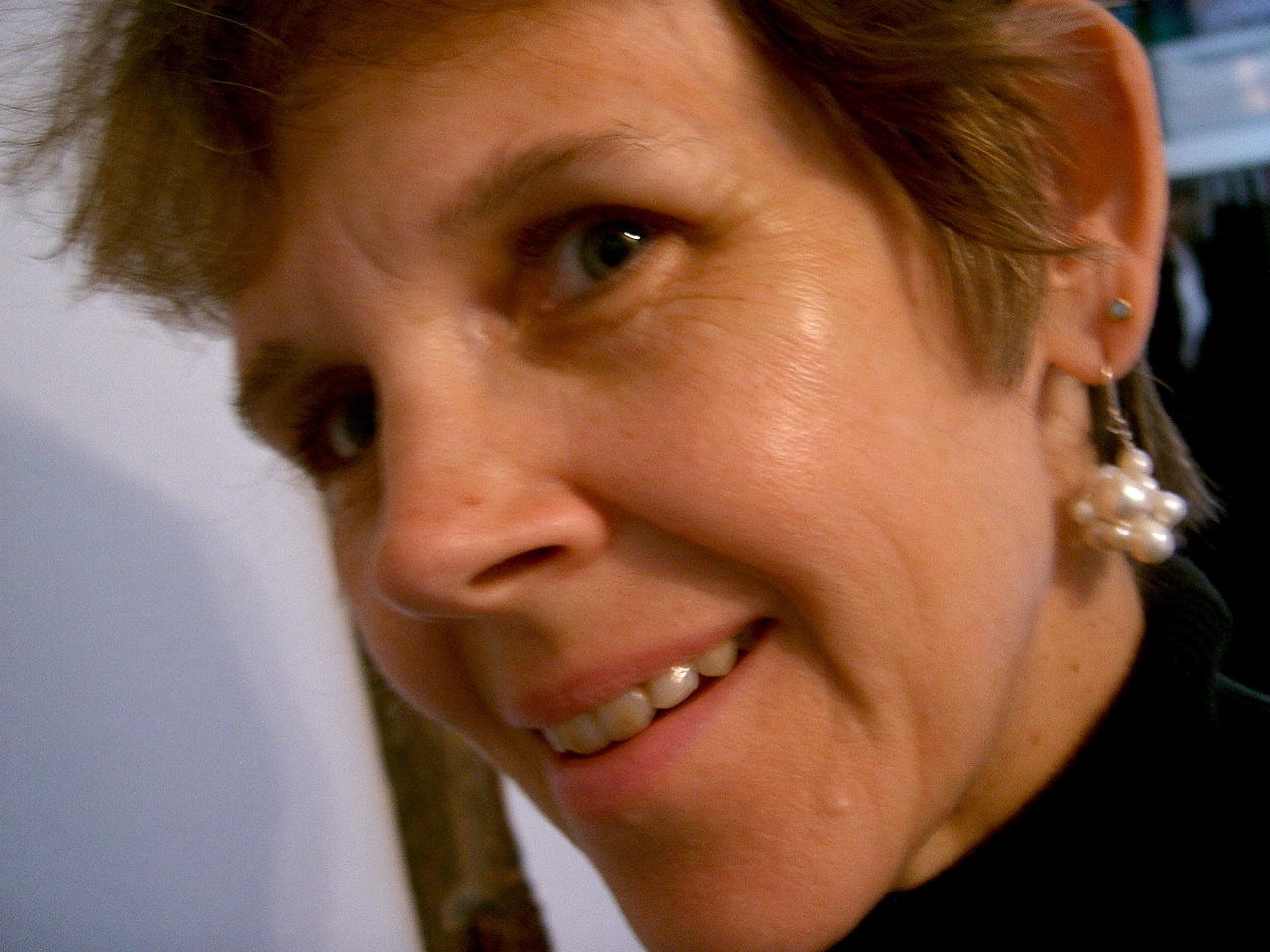 First I am a writer. My creation of mandalas, altered books, and mixed media assemblages grew out of that profession, and out of my practice of mosaic collage which has been evolving for more than a decade. Practically speaking, materials and my enjoyment of experimentation inspire me to pursue particular projects.
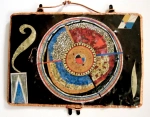
More profoundly, I am compelled by consistent conflicting energies in my personality, by my deep respect for the act of creation as a holy endeavor, and by the feeling of completeness and inner strength that come to me through the making of art. I am a fierce champion and great appreciator of the handmade. To personally create a piece that possesses its own original honesty and beauty takes me beyond the ephemeral experience of fun (indeed, the work is often tiring and tedious) to a more durable state of joy.
I work with materials salvaged and collected from nature, the street, demolition sites, thrift stores, and with papers I have salvaged or bought. 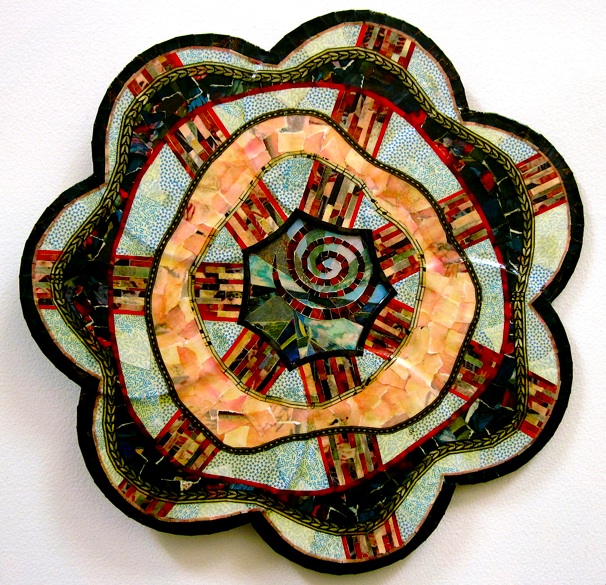 These materials include old art calendars and catalogues, used books, rusted metal, pressed flowers and leaves, roots, bark, sticks, beads, and unidentified interesting small objects. My tools are scissors, pencil, eraser, art pens, ruler, tweezers, exacto knife, sewing needle, punching tool, knitting needles, pliers, screwdrivers, and a large heavy-duty stapler. I also use a fair amount of white glue, PVA, craft glue, and polyurethane varnish. The main part of my collage process involves a sophisticated development of the scissors-and-paste method I learned in kindergarten.

I work at my dining room table which itself is a piece I collaged with small squares cut from art calendars, then gave five coats of polyurethane. It is washable.
******************************************************************************
Making Mandalas

Making mandalas has taught me that it is good to be centered and it is needful to have boundaries. Making mandalas has shown me how things grow. I have seen that
1. You must start from somewhere. Anywhere. Preferably the center. But anywhere. You must start.
2. It is perfect to be imperfect. Even more, it is beautiful.
3. What seems like not much in the beginning may add up to something good in the end–if you persevere.
4. It is not helpful to judge until a piece is finished. And even then it is not good to judge too much.
5. Repetition of the same simple, honest thing becomes beautiful.
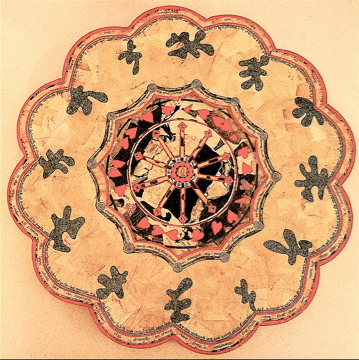
6. When you work from the center the piece maintains a measure of wholeness at every stage. As the circle grows it becomes more complex and interesting; it gains its depth.
7. Things that seem not to go together can go together if you let them and help them. This is called integration. There is integrity in that.
8. Surprises stand out in the context of a consistent pattern.
9. Many pieces go through an unattractive adolescent period. Don’t give up. Sometimes the ugliest adolescence develops into the most beautiful and unique maturity.
10. Expectations and preconceptions are often unhelpful. To create a piece that is alive one must be open to what it is and what it is becoming, and then help it to become that.
11. Courage is essential to creation.
12. Matisse said, “Truth and reality in art do not arise until you no longer understand what you are doing.” To me this is what it means to walk by faith–to proceed beyond what I know in order to discover something new and genuine. For me, to create is to truly live.
Here is a poem I found in a list of words I made out of letters of the word “refrigerator”:
To get fire: rare.
To free fire: rarer.
To err: oft.
Tiger at gate: go.
Forge art or fear.
Great gift after grief.
–Deborah O’Keeffe

******************************************************************************
Paper and Mixed-media Collage
I work with bits of cut or torn paper–many too small to pick up with my fingers–arranging them in free-form, concentric, mosaic, linear, and other patterns. Sometimes I incorporate non-paper materials such as cloth, pressed flowers, leaves, broken glass, scrap metal, and freshwater pearls, applying the materials to substrate such as discarded books and CD assemblages. In most circumstances I use Elmer’s Glue-All to adhere the bits of paper to the substrate; occasionally I use an archival white glue used by book artists, PVA. Once the collage is established, I seal the piece with multiple coats of varnish. Usually I use a gloss or semi-gloss polyurethane varnish I buy from the hardware store. Application of this varnish not only protects the surface, it coalesces and slightly antiques the colors. Because different papers absorb the varnish differently, the finishing sometimes creates interesting and surprising final effects. I embrace the slight unpredictability of these interactions as part of the process of the creation of a collage. When I do not want the collage to change too much in the varnishing process, I use a satin water-based polycrylic varnish, also available at some hardware stores.
–Deborah O’Keeffe
******************************************************************************
 ameliamandala
I”m enjoying your writing and looking at your art….your writing is deep, meaningful, and interesting. I’m not ‘artistic’ at all…..possibly you might be inspiring me to try something. You are interesting and I will be back to see and read more. Thanks so much!
Thank you, Jane. I appreciate your comment very much. Creativity is for all disciplines and experiences of life, I believe, not only for the arts. Best to you in whatever you choose to apply your creativity to. D
I saw your work at Anderson Park in Upper Montclair today. I was so incredibly drawn into the booth. We discussed Sisyphus a bit. I hesitated because I didn’t want to buy the first thing I saw, but I didn’t see anything else that moved me so much. I particularly love the books. I was sure I had taken your information; however I couldn’t find it. I am so grateful that the sponsors of the show had an exhibitor list online. If you will be at the Brookdale Park show, please let me know and I will visit you there. You have inspired me tremendously.
What beautiful art. I just finished a book on the O’henro trail on Shikoku and your work reminded me of a passage. “The path is the ending, and the endings beginnings”.
I look forward to meeting you someday.
Hi Deborah, A friend recently directed me to your website. Your work is amazing and I appreciate all the insight and details you share about it. Thank you so much and God bless!
Love your work; I’m a jewelry designer incorporating a mixed media array, tyvek, paper of all kinds, metal, wire, found objects, glass beads, stones, and whatever on my bracelets and necklaces; I want a really good sealer on the completed piece; sounds like polyurethane varnish in multiple coats would work; Do you use water base poly or oil base…I want a clear, clean, satin or gloss finish; would the water-based polycrylic work as well as the poly varnish??? I also do collage with the same array of stuff and I love the finishes you apply…thanks for the inspiration and any suggestions you can share with me. Respectfully, Claudette Pehde
My apologies, Claudette. I haven’t looked at my website for months, and did not see your question until today. I use Minwax Fast-Drying Polyurethane on most of my pieces. It is not water base, but I don’t think it is strictly oil base, either; the oil-based varnishes seem to behave a little differently. The regular polyurethane will yellow a piece a little right away. Usually I like that effect. If you don’t like that effect, try Polycrylic. Minwax makes that, too, in a blue can. It is water based. It looks a little milky in the can, but it dries clear and the colors remain exactly as they were. Hope this helps! D
Thank you mucho for the info and taking the time to reply; I will use the Minwax products you mentioned much more now in my sealing process…I do like the look of the polyurethane finish…I am inspired by your creative spirit and the use of whatever appears…your detail is quite amazing; I will look at your website often. Thanks again, Claudette
Pingback: 2016-057 – Cycle of Life Mandala | Mandala of the Day